
 0 items –
Commercial Catering Equipment and Supplies at Display-Fridge Wholesale Ltd
Free Resources for UK Food Businesses
Free logs, checklists and calculators for UK cafés, bakeries, butchers, delis and food shops. Use them to keep fridges at the right temperature, show an inspector your records and cut running costs. Download them as PDF or Excel, or fill them in online.
All free resources
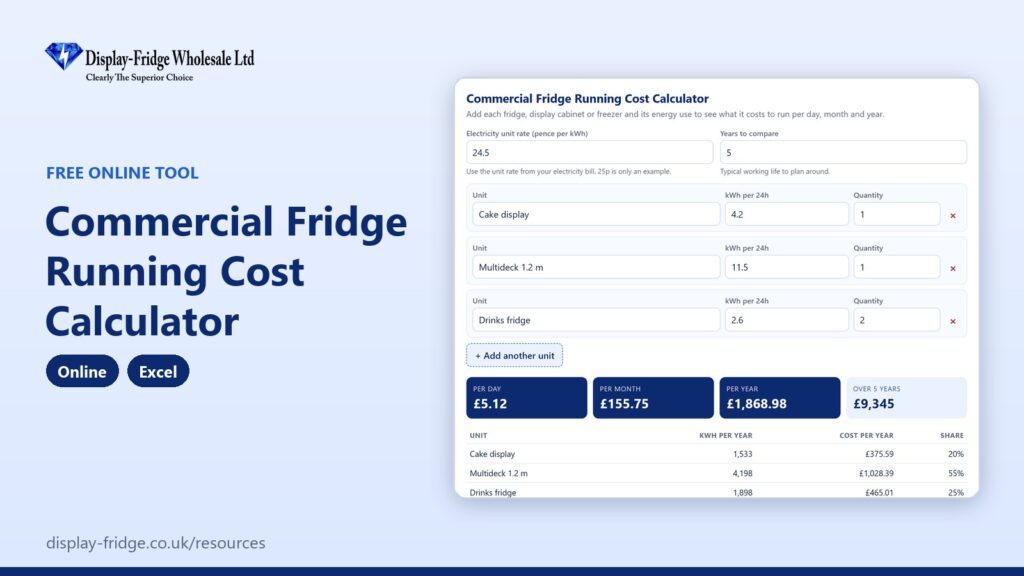
Commercial Fridge Running Cost Calculator
See what each fridge costs to run per day, month and year, and when a new one pays for itself.
Free Fridge & Freezer Temperature Log Sheet
Record every fridge and freezer at opening and closing, plus hot holding. PDF, Excel or online.
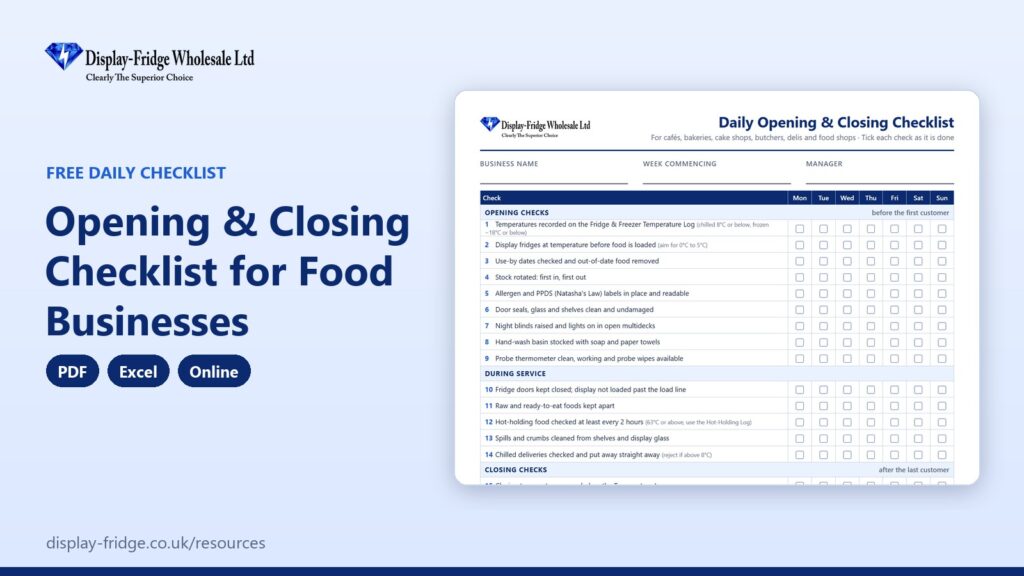
Free Opening & Closing Checklist for Food Businesses
21 daily checks and weekly equipment care, with a score for each day. PDF, Excel or online.
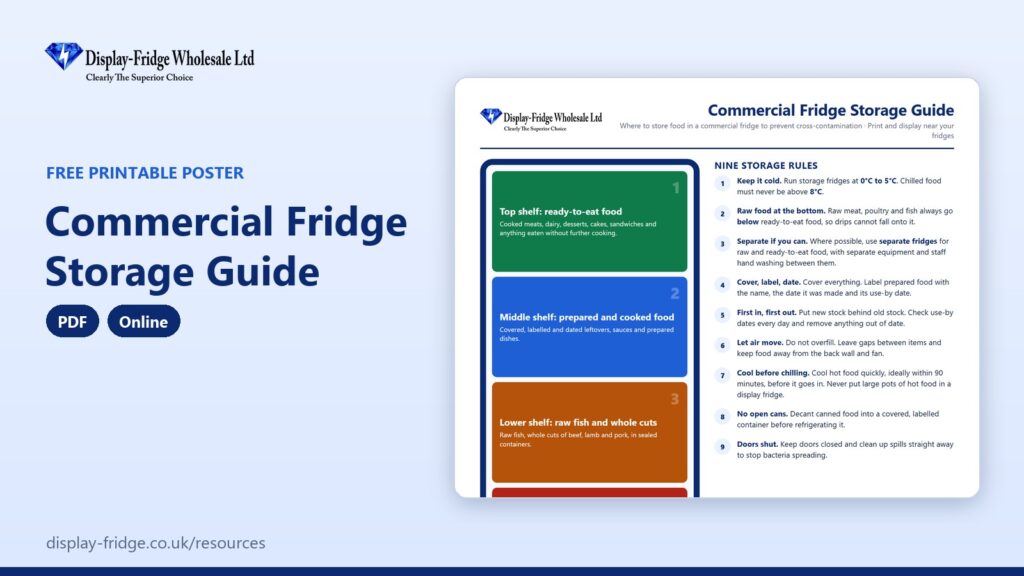
Free Commercial Fridge Storage Guide (Printable Poster)
Which shelf each food belongs on, as a printable A4 poster and an interactive finder.
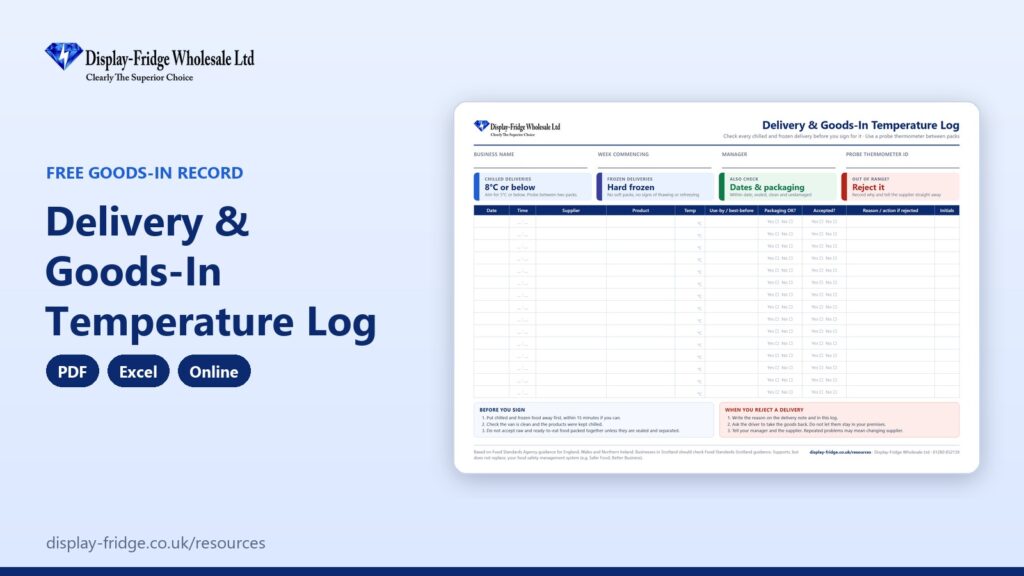
Free Delivery & Goods-In Temperature Log
Check every chilled and frozen delivery before you sign for it. PDF, Excel or online.
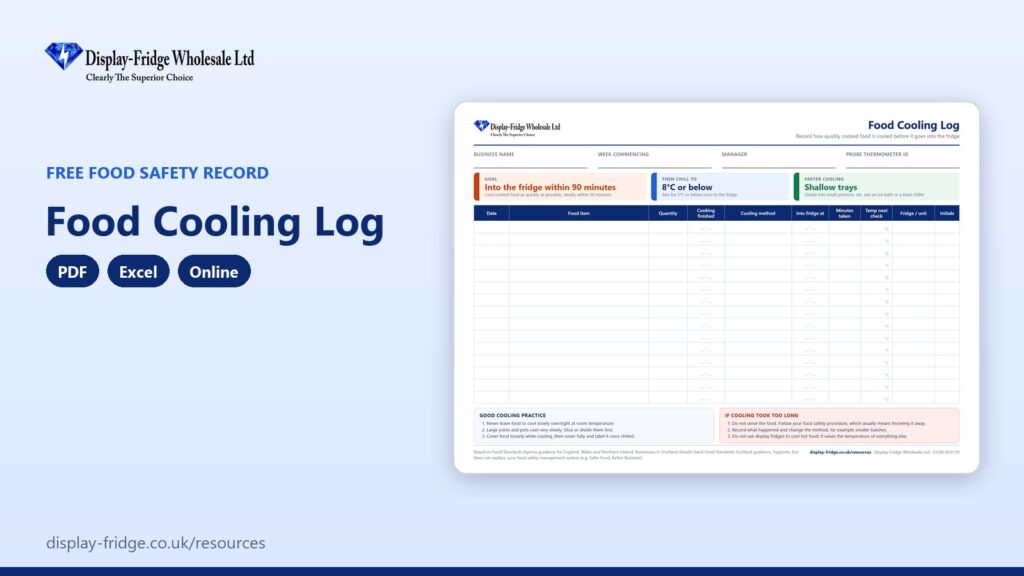
Free Food Cooling Log
Record how quickly cooked food is cooled before it goes into the fridge. PDF, Excel or online.
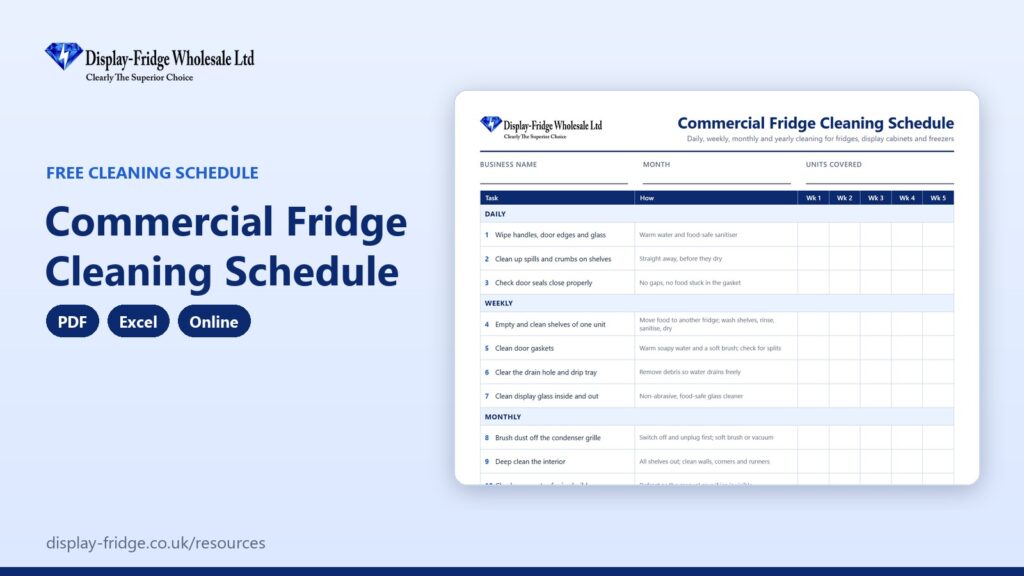
Free Commercial Fridge Cleaning Schedule
Daily, weekly, monthly and yearly cleaning tasks, with due dates worked out for you.
Fridge Breakdown Emergency Plan: What to Do When a Commercial Fridge Fails
Eight steps to protect your food when a fridge stops working, with an emergency contacts sheet.
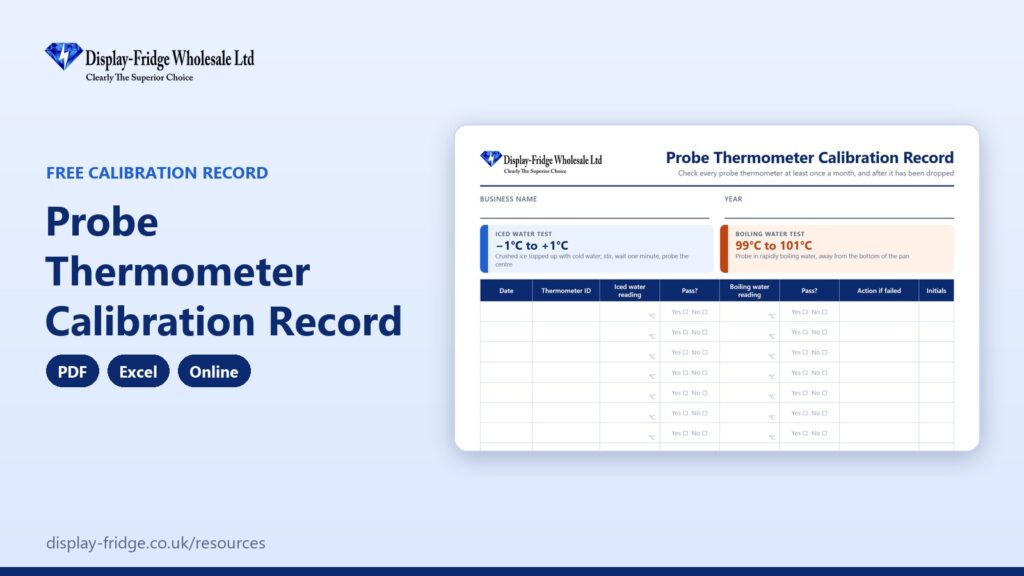
Free Probe Thermometer Calibration Record
Check your probe thermometers in iced and boiling water, with pass or fail worked out for you.
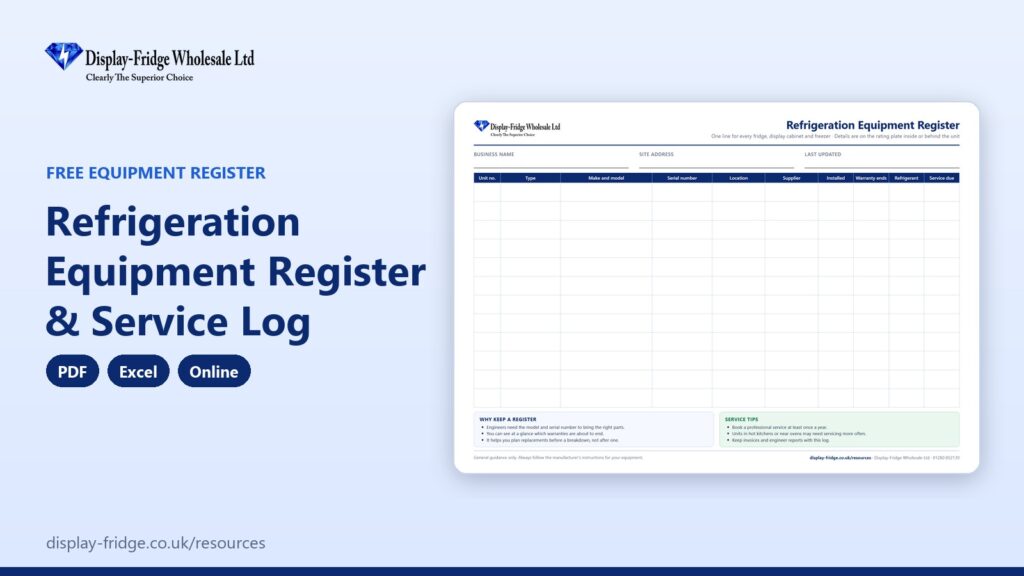
Free Refrigeration Equipment Register & Service Log
One record of every fridge and freezer, with service dates, warranties and repair costs.
Free Commercial Fridge Buying Checklist
Everything to check before you buy a commercial fridge, plus a calculator to compare models.
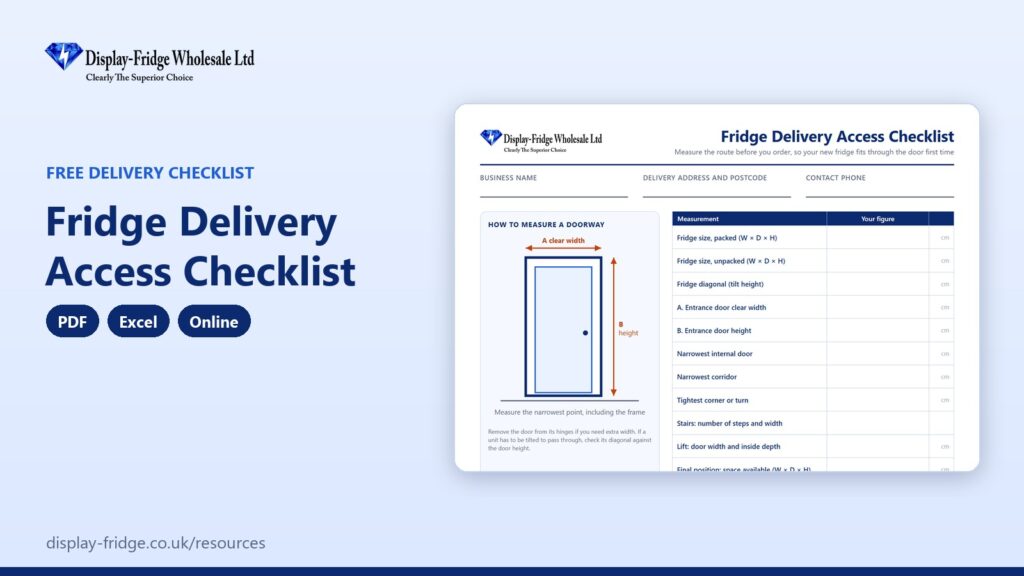
Free Fridge Delivery Access Checklist: Will It Fit?
Measure doors, corridors and lifts so your new fridge fits through first time.
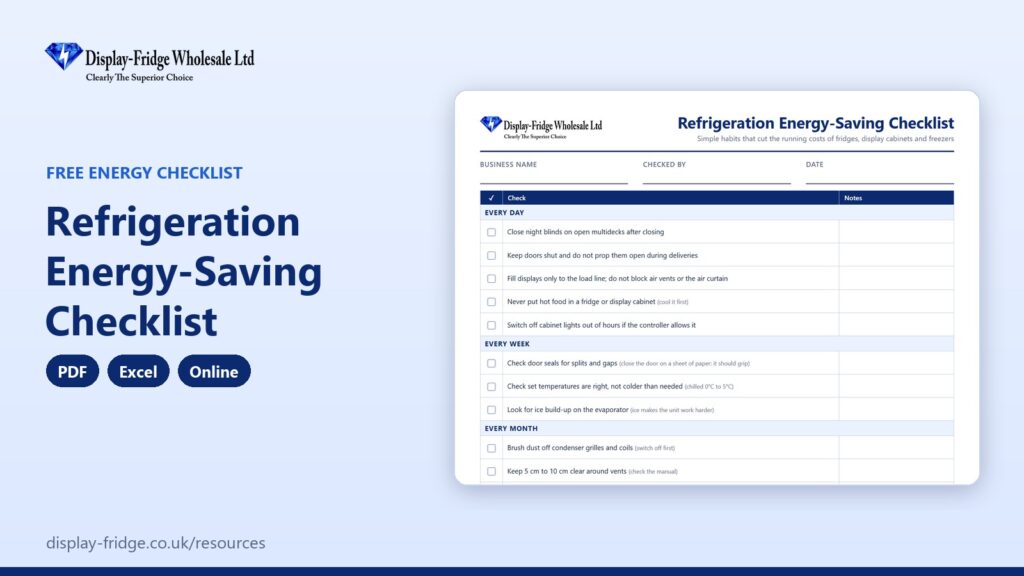
Free Refrigeration Energy-Saving Checklist
Simple habits that cut the running costs of fridges, display cabinets and freezers.



Frequently asked questions
What are these free resources for UK food businesses?
Ready-made food safety records, checklists and calculators written for businesses that use commercial fridges, display cabinets and freezers. They include a fridge and freezer temperature log, a daily opening and closing checklist and a running cost calculator, with more being added.
What are these resources for?
They help you do three things: keep food at safe temperatures and spot problems early; keep written records that show an environmental health officer (EHO) your checks are done every day; and understand what your refrigeration costs to run, so you can make better buying and replacement decisions.
Who can use these resources?
Any food business that stores or displays chilled, frozen or hot food: cafés and coffee shops, bakeries and cake shops, butchers, delis, farm shops, convenience stores, takeaways, pubs, restaurants and caterers. Owners, managers and every member of staff on shift can use them.
Why should my business use these resources?
Food businesses must keep chilled food at 8°C or below and must have food safety procedures based on HACCP principles. Written records are the usual way to show that those procedures work. During an inspection, the officer looks at how food is handled, the condition of the premises and how confident they can be in your management of food safety. Clear, complete records help with all three.
Records also protect you. If something goes wrong, being able to show that you took all reasonable precautions can form part of a due diligence defence under the Food Safety Act 1990.
Where should we use these resources?
Wherever the checks happen. Print the PDF and keep it on a clipboard next to the fridges, or keep the Excel or online version open on a tablet in the kitchen or behind the counter. Use the calculators in the office when you plan budgets or compare equipment.
When should we use these resources?
Temperature checks at least twice a day, at opening and at closing. Opening and closing checks every day. Weekly checks, such as calibrating your probe thermometer and cleaning door gaskets, on a fixed day. Use the calculators when bills rise, when a unit starts to struggle and before you buy new equipment.
Are these resources really free? Do I need to sign up?
Yes, they are free and there is no sign-up. You can print them, share them with your team and use them in as many sites as you like. If you find them useful, a link to this page from your website or staff handbook is always appreciated.
Do these resources replace Safer Food, Better Business or our HACCP plan?
No. They support your food safety management system. Many businesses use them alongside Safer Food, Better Business (SFBB) or their own HACCP plan, as the day-to-day records that show the plan is being followed.
Can I edit these resources or add my own checks?
Yes. The Excel versions can be edited: you can rename units, add checks that suit your business and change the settings. Keep the legal temperature limits unless your own food safety procedure sets stricter ones.
Where is the information I type into the online resources stored?
Only in the browser on your own device. Nothing you type into the online versions is sent to us. Print or download your records regularly, because clearing your browser data also clears them.
Are these resources suitable for businesses in Scotland?
Yes, with care. They follow Food Standards Agency guidance for England, Wales and Northern Ireland. Food Standards Scotland publishes its own guidance, so check it and adjust the settings if your requirements differ.
Your business with our resources, and without
| Using our free resources | Without them | |
|---|---|---|
| Temperature checks | Recorded twice a day on a ready-made log; out-of-range readings flagged in red | Readings forgotten, written on scraps of paper or not taken at all |
| Food hygiene inspection | Records ready to show the inspector, filed week by week | Hard to prove that checks happen |
| Spotting problems | Rising temperatures noticed early, before food is lost | A fault is found when the food is already warm |
| Staff routines | Every shift follows the same opening and closing checks | Each person does it differently, or skips steps |
| Corrective action | An action column for every problem, so nothing goes unrecorded | Problems fixed, but no record of what was done |
| Running costs | You know what each unit costs per year and when a replacement pays for itself | Bills rise with no idea which unit is to blame |
| Cost to you | Free, with PDF, Excel and online versions | Paid templates, or hours spent making your own |
Why these resources matter
A commercial fridge is one of the hardest-working pieces of equipment in a food business. It runs every hour of every day, it holds stock worth hundreds or thousands of pounds, and it is one of the first things an inspector looks at. Yet many small businesses still check temperatures from memory, keep records on loose paper or only find a fault when food is already warm.
Temperature control is the law
In England, Wales and Northern Ireland, chilled food must be kept at 8°C or below. The Food Standards Agency recommends running fridges at 5°C or below to give a safety margin. Hot food on display must be kept at 63°C or above, and freezers should run at −18°C or colder. Bacteria multiply fastest between 8°C and 63°C, which is why a fridge that drifts a few degrees too warm is a food safety problem, not just an equipment problem.
Records are your evidence
Every food business needs procedures based on HACCP principles, and every one of those procedures needs evidence that it is followed. A completed temperature log and a ticked opening and closing checklist are that evidence. They show the inspector that checks happen every day, that someone is responsible for them and that problems are acted on. Under the Food Hygiene Rating Scheme, confidence in management is one of the three things your score is based on.
Good records save money
A temperature log is also an early warning system. A unit that creeps from 3°C to 6°C over a few weeks is telling you something: a dirty condenser, a worn door seal or a failing fan. Spotting the trend early means a cheap repair instead of a lost delivery of stock and an emergency call-out. Our guide to the signs your commercial fridge is dying explains what to look for.
Energy is the other cost. Refrigeration runs around the clock, so small differences in efficiency add up over a year. The running cost calculator shows what each unit costs to run and how long a more efficient model takes to pay for itself.
A routine your whole team can follow
The best record-keeping system is the one people actually use. These resources are designed to take a minute or two at a time: a reading at opening, a reading at closing and a few ticks on the checklist. Because the same sheet is used every day, new staff learn the routine quickly and managers can see at a glance whether anything was missed.
How the resources fit together
- Every day: record temperatures on the Fridge & Freezer Temperature Log and work through the Daily Opening & Closing Checklist.
- Every week: check your probe thermometer, clean door gaskets and review the week’s records. Both are part of the checklist.
- Every month: file the completed logs and look for units that are often amber or red.
- When you plan or buy: use the Running Cost Calculator to compare running costs before you choose new equipment.
These resources follow Food Standards Agency guidance for England, Wales and Northern Ireland. If your business is in Scotland, check the guidance from Food Standards Scotland. They support your food safety management system, such as Safer Food, Better Business, and do not replace it.