
 0 items –
Commercial Catering Equipment and Supplies at Display-Fridge Wholesale Ltd
Free Fridge & Freezer Temperature Log Sheet
A free fridge and freezer temperature log for UK food businesses. Record every unit at opening and closing, plus hot-holding checks, and see straight away when a reading is out of range.
Fill in the log online
Online Fridge & Freezer Temperature Log
Fill it in on screen, every day. Readings turn green, amber or red automatically. Your entries are saved in this browser, and you can print or download them at any time.
| Date | Time | Food item | Cabinet | Core °C | Result | Action if below the minimum | Initials |
|---|
Green: within target. Amber: above the fridge target but within the legal limit. Red: out of range, so write the action you took. Based on FSA guidance for England, Wales and Northern Ireland; in Scotland check Food Standards Scotland guidance. Entries are stored only in this browser on this device, so print or download them for your records.
Free tool by Display-Fridge Wholesale
Frequently asked questions
What is a fridge temperature log sheet?
A record of the temperature of each fridge, display cabinet and freezer, taken at set times every day. Ours has space for six units, two checks a day, the action you took if a reading was out of range and the initials of the person who checked. A second page covers hot holding.
What is a fridge temperature log sheet for?
It shows that your chilled and frozen food is kept at safe temperatures and that problems are dealt with. It also gives you an early warning when a unit starts to struggle.
Who needs to use a fridge temperature log?
Any business that stores or displays chilled or frozen food: cafés, bakeries, cake shops, butchers, delis, convenience stores, takeaways, pubs and restaurants. The person on shift fills it in; the manager reviews and signs it.
Is a fridge temperature log a legal requirement?
The law requires chilled food to be kept at 8°C or below in England, Wales and Northern Ireland, and requires food businesses to have food safety procedures based on HACCP principles. It does not prescribe a particular form, but written temperature records are the usual way to show that your procedures work, and inspectors expect to see them.
What temperature should a commercial fridge be?
Chilled food must be at 8°C or below. Aim to run fridges between 0°C and 5°C to give yourself a margin. Freezers should be at −18°C or colder, and hot food on display must be at 63°C or above.
How often should I check fridge temperatures?
At least twice a day: before you open and after you close. Check display fridges more often on hot days, after deliveries and if a unit has had a problem recently.
Where should the fridge temperature log sheet be kept?
Next to the fridges, where staff will see it: on a clipboard, inside a cupboard door or on a tablet using the online or Excel version. File completed sheets with your food safety records.
What should I do if a reading on the fridge temperature log is out of range?
Re-check with a probe thermometer, check the door, seals, load line and air vents, and re-check after 30 minutes. If it is still too warm, move food to a working unit and call your engineer. Write what you did in the Action column. Food above 8°C for an unknown time should be dealt with according to your food safety procedure: if in doubt, throw it out.
How long should we keep completed fridge temperature logs?
For as long as your food safety management system says. Keep enough to show an inspector a full history since their last visit, and keep any records linked to a complaint or incident.
How does a fridge temperature log help my business?
It protects stock, shows inspectors that you are in control and catches equipment faults early, when repairs are cheaper.
Is the online fridge temperature log saved?
Yes, in the browser on your device only. Nothing is sent to us. Print or download a CSV file regularly to keep your own records.
Your business with our temperature log, and without
| Using our temperature log | Without it | |
|---|---|---|
| Daily checks | Every unit checked at opening and closing, in the same place | Checks depend on who is on shift |
| Out-of-range readings | Shown in red, with a column for the action taken | Warm readings noted, with nothing recorded about what happened next |
| Inspections | A month of records ready to show the inspector | No evidence that checks are made |
| Equipment faults | Gradual rises spotted early | Faults found when food is already warm |
| Hot holding | Core temperatures recorded every 2 hours | Hot food left below 63°C without anyone noticing |
| Format | PDF, Excel and online, free | Home-made sheets that miss important details |
Why temperature records matter
Temperature is the single most important control for chilled food. Bacteria multiply fastest between 8°C and 63°C, so a fridge that drifts a few degrees too warm shortens the safe life of everything inside it. Display fridges are especially at risk: their doors are opened all day, their lights add heat and many stand on a warm shop floor.
What the law and the inspector expect
Chilled food must be kept at 8°C or below in England, Wales and Northern Ireland, and hot food on display at 63°C or above. Every food business must also have food safety procedures based on HACCP principles. During an inspection, the officer will want to see how you check that your fridges are working. A completed log, with actions written down, is the clearest answer. Our article on complying with food safety rules covers the wider picture.
An early warning for your equipment
A log does more than satisfy an inspector. When you look back over a few weeks, you can see patterns that a single reading would miss: a multideck that is always amber in the afternoon, a freezer that creeps up after every delivery, a cake display that never quite reaches 5°C. These are often the first signs that a commercial fridge is failing, and a cheap repair now can save a full load of stock later.
Hot holding counts too
If you sell pies, pasties or sausage rolls from a heated display cabinet, the food must stay at 63°C or above. Probe the centre of the food, not the air in the cabinet, at least every 2 hours. Hot food can be kept below 63°C for a single period of up to 2 hours; after that, reheat it until steaming hot or throw it away, as your food safety procedure says.

How to use the temperature log, step by step
Set it up once
Enter your business name and the month. Rename each unit, for example ‘Cake display’ or ‘Back freezer’, and set it to Chill or Freeze. The limits follow FSA guidance; change them only if your food safety procedure is stricter.
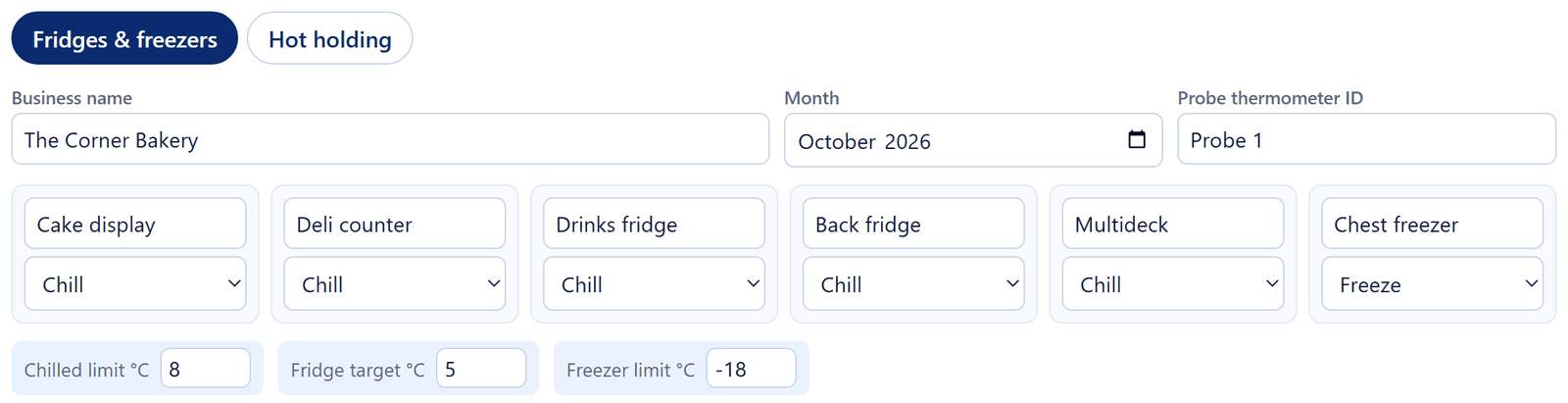
Setting up the online temperature log with unit names and types Record each unit at opening and closing
Use a probe thermometer where you can, and type the number only, for example 4 or −19. Green means within target, amber means above 5°C but within the legal limit, and red means out of range. When the Status column shows ‘Action needed’, write what you did in the Action column and add your initials.
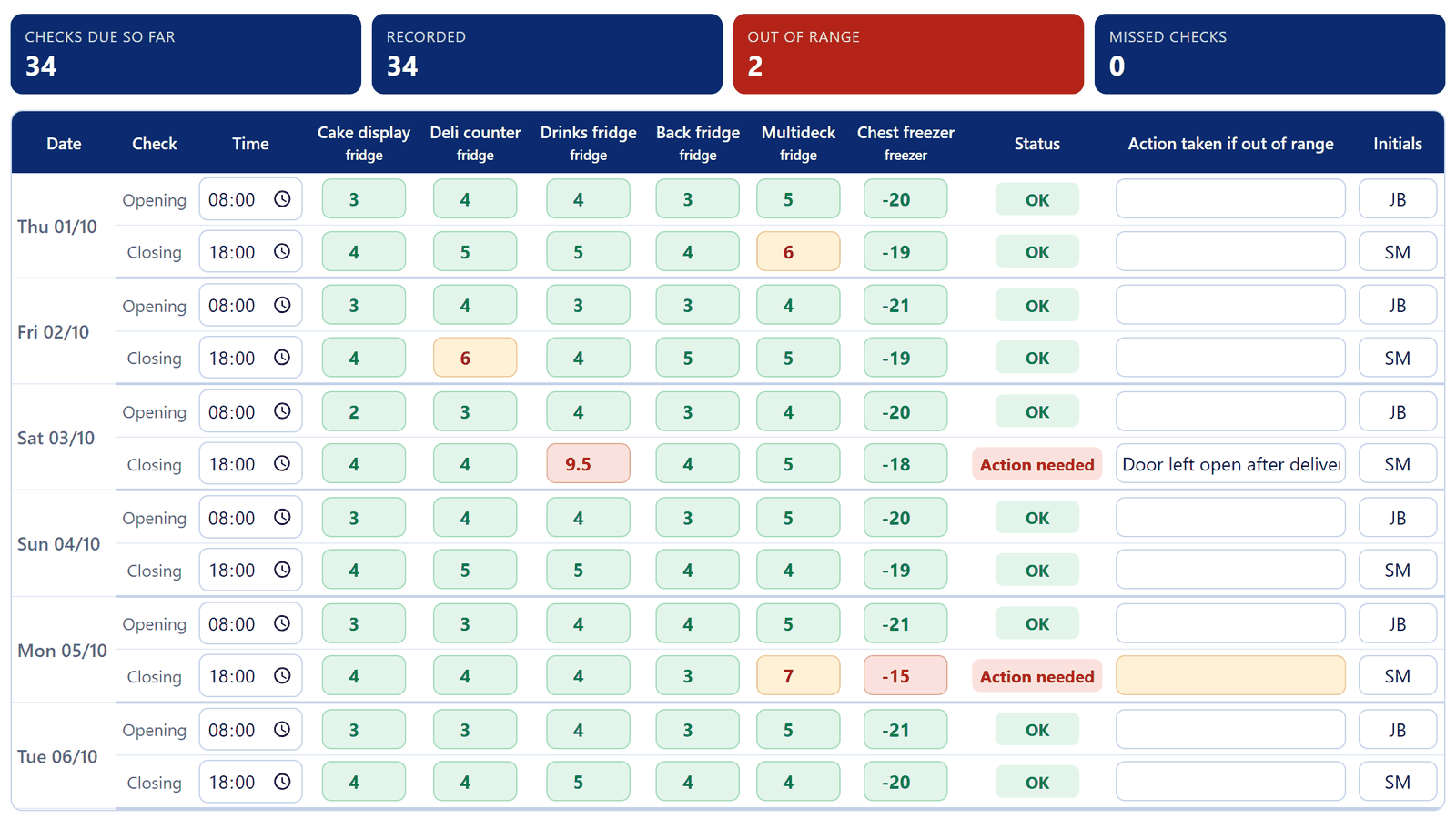
Readings colour-coded green, amber and red, with an action recorded Log hot holding
Switch to the Hot holding tab and add a row for each check of food in a heated cabinet. Anything below 63°C is flagged.

Hot-holding checks with one reading below 63°C Keep your records
Print the month or save it as a PDF, or download a CSV file that opens in Excel. Prefer paper? Print the PDF log and keep it on a clipboard next to the fridges.

Print, download and clear buttons of the online log
Taking an accurate reading
- Read temperatures before you open and after closing, when the doors have been shut for a while.
- Use a probe thermometer in a glass of water left in the fridge, or between two packs. The display on the unit shows air temperature and can mislead.
- Once a week, compare the display with your probe. If they are more than 2°C apart, book a service.
- Check your probe thermometer monthly in iced water (−1°C to +1°C) and boiling water (99°C to 101°C).
Fridges that hold temperature
If a unit keeps showing amber or red, it may be time to replace it. Browse patisserie display fridges, deli and serve-over counters, multideck fridges, heated display cabinets and commercial freezers, all delivered and installed by a two-person team.
Related free resources
- Daily Opening & Closing Checklist: the temperature check is the first item every morning.
- Running Cost Calculator: find out what each of your units costs to run.
- All free resources.
These resources follow Food Standards Agency guidance for England, Wales and Northern Ireland. If your business is in Scotland, check the guidance from Food Standards Scotland. They support your food safety management system, such as Safer Food, Better Business, and do not replace it.