
 0 items –
Commercial Catering Equipment and Supplies at Display-Fridge Wholesale Ltd
Free Food Cooling Log
A free food cooling log for UK food businesses. Record when cooking finished and when food went into the fridge: the minutes are worked out for you, and anything over 90 minutes is flagged.
Fill in the cooling log online
Online Food Cooling Log
Record when cooking finished and when the food went into the fridge. Minutes are worked out for you; anything over 90 minutes is flagged.
Based on FSA guidance for England, Wales and Northern Ireland; in Scotland check Food Standards Scotland guidance. Entries are stored only in this browser on this device, so print or download them for your records.
Free tool by Display-Fridge Wholesale
Frequently asked questions
What is a food cooling log?
A record of each batch of cooked food you cool: the food, the quantity, when cooking finished, how it was cooled, when it went into the fridge and its temperature at the next check.
What is the food cooling log for?
It shows that cooked food is cooled quickly enough to stop bacteria from multiplying, and that you act when cooling takes too long.
Who needs a food cooling log?
Any business that cooks food in advance and keeps it to serve later: cafés, takeaways, restaurants, pubs, caterers, bakeries with savoury products and delis that cook meats.
How quickly should cooked food be cooled?
As quickly as possible, ideally within 90 minutes, before it goes into the fridge. Then keep it at 8°C or below, ideally 5°C or below.
Which foods need the most care when cooling?
Rice, pasta, stews, soups, sauces, gravies, curries and large joints of meat: they hold heat and some can carry bacteria whose spores survive cooking.
Where should the food cooling log be kept?
In the kitchen, next to where food is cooled, or on a tablet using the online or Excel version.
When should a batch be recorded?
Every time cooked food is cooled to be kept for later, from the moment cooking finishes.
What if cooling took longer than 90 minutes?
Follow your food safety procedure, which usually means throwing the food away. Record what happened and change the method, for example smaller batches or an ice bath.
How does a food cooling log help my business?
It reduces the risk of food poisoning from batch-cooked food, shows inspectors your cooling is controlled and highlights dishes that need a better method.
Is the online food cooling log saved?
Yes, in the browser on your device only. Nothing is sent to us. Print it or download a CSV file regularly.
Your business with our cooling log, and without
| Using our cooling log | Without it | |
|---|---|---|
| Cooling times | Worked out for every batch; over 90 minutes is flagged | Nobody knows how long food took to cool |
| Problem dishes | Easy to see which dishes cool too slowly | The same mistake repeated every day |
| Inspections | Evidence that cooked food is cooled safely | Hard to answer the inspector's questions |
| Fridge temperature | Food cooled before it goes in, so other food stays cold | Hot pots warm the whole fridge |
| Staff | One method everyone follows | Food left on the side overnight |
| Format | PDF, Excel and online, free | Times remembered, not written down |
Why cooling cooked food matters
Cooking kills most bacteria, but some produce spores that survive and start to grow again as food cools. They grow fastest between 63°C and 8°C. The longer cooked food spends in that range, the more they multiply, and some produce toxins that reheating will not destroy. Rice, stews, soups, gravies and large joints are the usual culprits.
The 90-minute target
The Food Standards Agency’s Safer Food, Better Business guidance is to cool food as quickly as possible, ideally within 90 minutes, and then put it in the fridge. A cooling log records when cooking finished, how the food was cooled and when it went into the fridge, so you can show that the target is met.
How to cool food faster
- Divide large batches into smaller portions.
- Spread food out in shallow trays rather than deep pots.
- Stand containers in a sink of iced water and stir.
- Slice large joints of meat.
- Use a blast chiller if you have one.
- Cover loosely while cooling, then cover fully, label and date once cold.
Never cool food in a display fridge
Putting a large pot of hot food into a display fridge or a full storage fridge warms everything around it. The unit struggles, other food rises above 8°C and the hot food still cools slowly. Cool first, then refrigerate, and check the fridge on the temperature log.

How to use the cooling log, step by step
Check the settings
Enter your business name. The target is 90 minutes and the chilled limit 8°C; change them only if your food safety procedure is stricter.

The target time, chilled limit and summary counters Add each batch
Tap ‘+ Add a batch’. Enter the food, the quantity, the time cooking finished and the cooling method. When the food goes into the fridge, enter that time: the minutes are worked out for you.
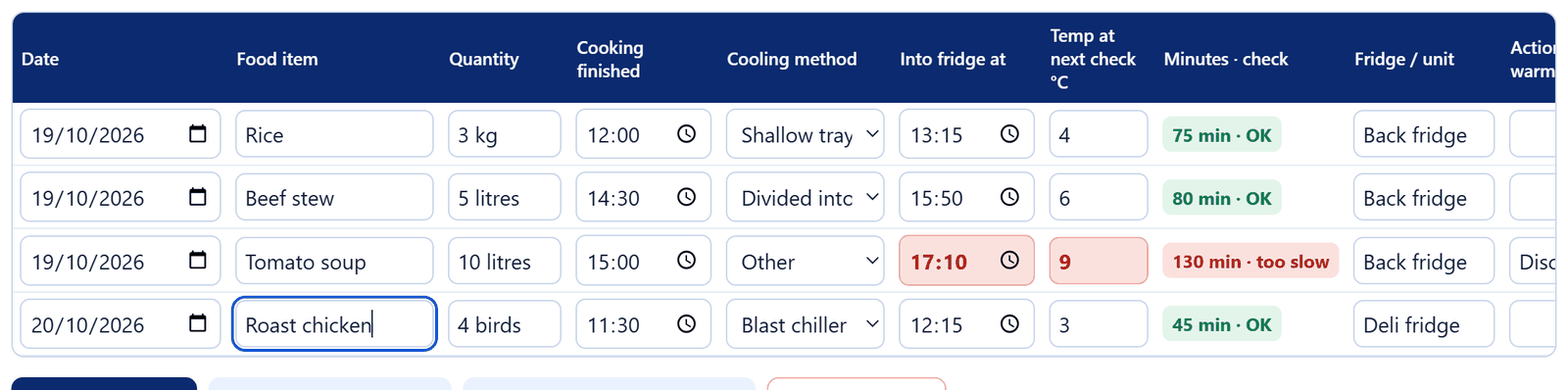
Four batches: one took 130 minutes and is flagged Act on anything red
If cooling took too long or the food was above 8°C at the next check, write what you did in the action column, for example ‘Discarded; next time 2-litre containers in an ice bath’.
Keep your records
Print the log or save it as a PDF, or download a CSV file for Excel. Prefer paper? Print the PDF log and keep it in the kitchen.

Add, print, download and clear buttons
Reheating cooled food
When you reheat food that has been cooled and chilled, reheat it until it is steaming hot all the way through, and only reheat it once. If it is going on display, keep it at 63°C or above in a heated display cabinet and check it every 2 hours on the hot-holding page of the temperature log.
Related free resources
- Commercial Fridge Storage Guide: store cooled food on the right shelf.
- Fridge & Freezer Temperature Log: check the fridge stays cold after food goes in.
- Probe Thermometer Calibration Record: make sure your probe reads correctly.
- All free resources.
These resources follow Food Standards Agency guidance for England, Wales and Northern Ireland. If your business is in Scotland, check the guidance from Food Standards Scotland. They support your food safety management system, such as Safer Food, Better Business, and do not replace it.