
 0 items –
Commercial Catering Equipment and Supplies at Display-Fridge Wholesale Ltd
Free Commercial Fridge Storage Guide (Printable Poster)
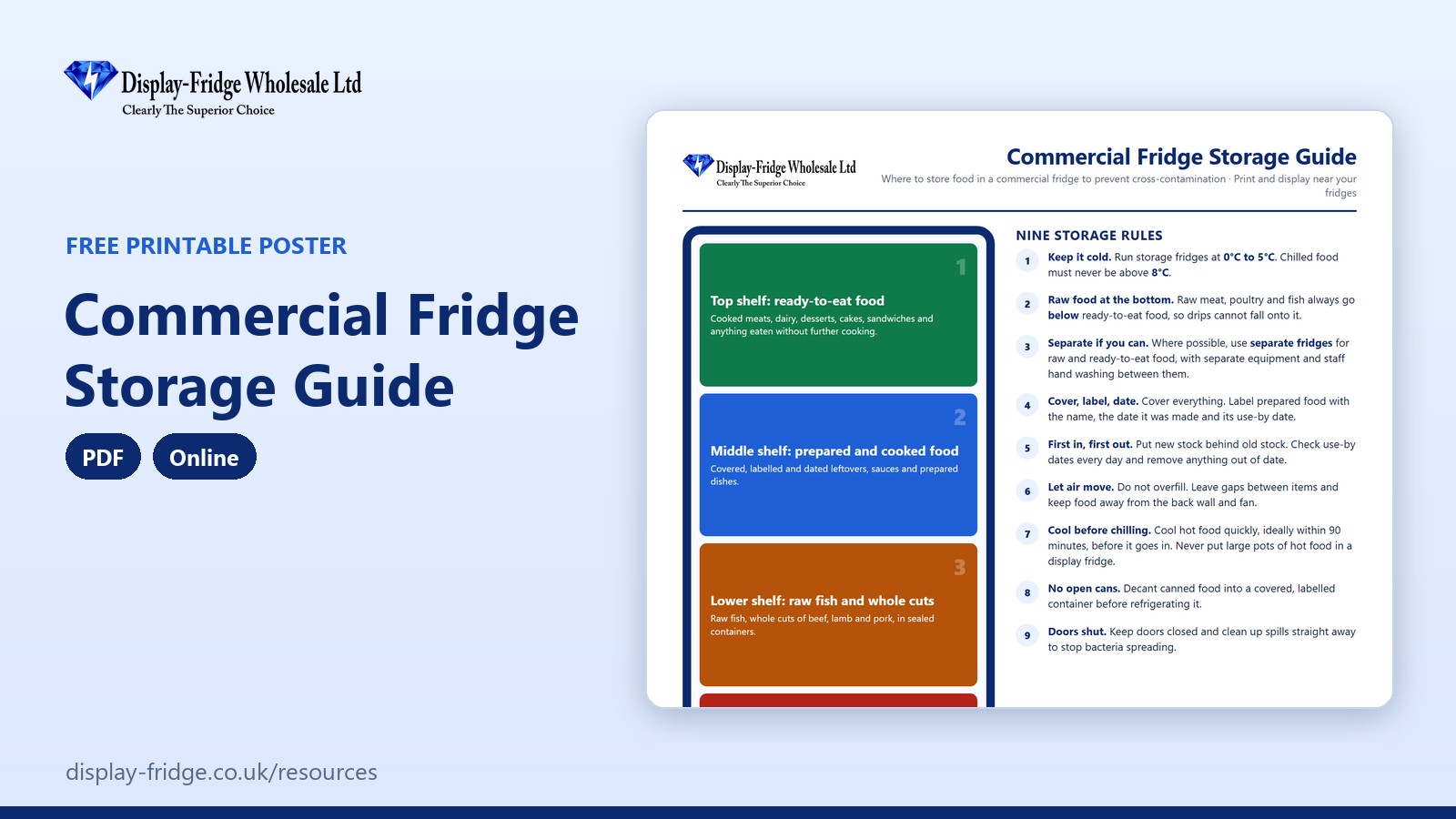
A free commercial fridge storage guide: a printable A4 poster showing which shelf each food belongs on, and an interactive finder that explains why. Print it and put it on every fridge door.
Find the right shelf online
Where Does It Go? Fridge Storage Finder
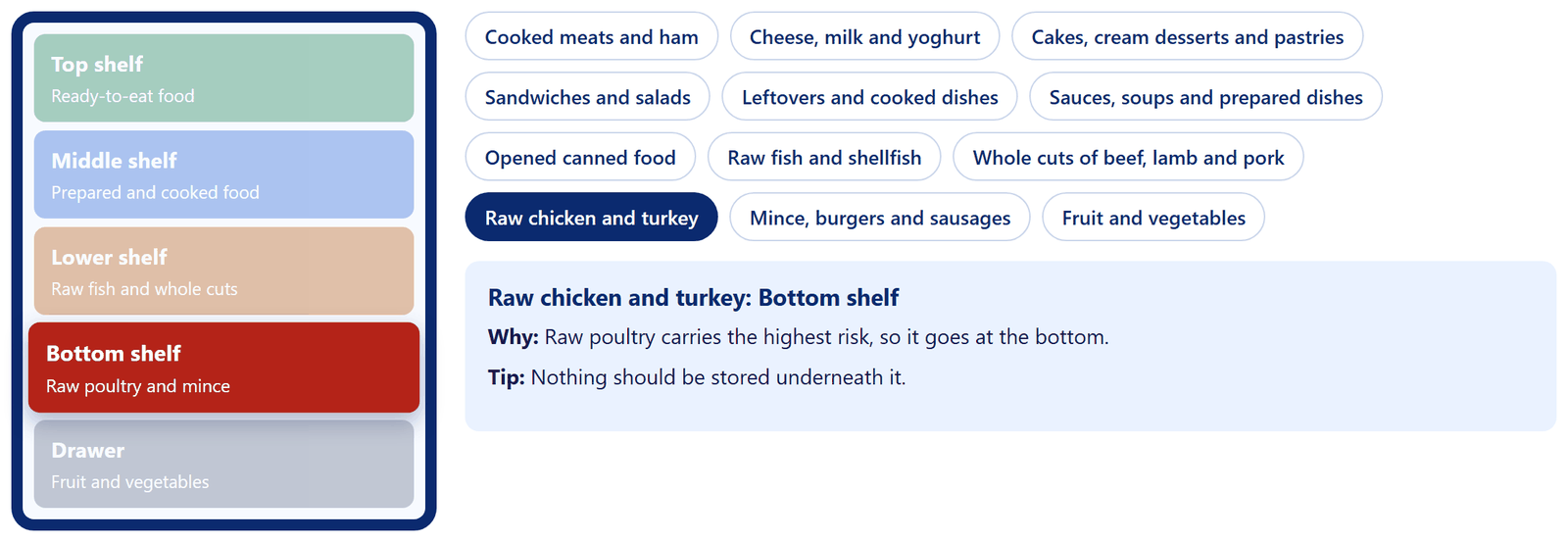
Tap a food to see which shelf it belongs on, and why. Ready-to-eat food always goes above raw meat, poultry and fish.
Choose a food
The shelf lights up on the fridge, with the reason and a storage tip.
Based on FSA guidance for England, Wales and Northern Ireland. Where possible, use separate fridges for raw and ready-to-eat food. Keep fridges at 0°C to 5°C; chilled food must never be above 8°C.
Free tool by Display-Fridge Wholesale
Frequently asked questions
What is the commercial fridge storage guide?
A one-page poster that shows where each type of food should go in a commercial fridge, from ready-to-eat food on the top shelf to raw poultry on the bottom, with nine storage rules alongside.
What is the fridge storage guide for?
It prevents cross-contamination by making sure raw food can never drip onto food that will not be cooked again. It also reminds staff about covering, labelling, rotating stock and leaving space for air.
Who should use the fridge storage guide?
Everyone who puts food into a fridge: kitchen staff, delivery staff, counter staff and managers in cafés, bakeries, butchers, delis, takeaways, pubs and food shops.
Why does the order of shelves matter?
Raw meat, poultry and fish can carry harmful bacteria. If they are stored above ready-to-eat food, drips can carry those bacteria onto food that is eaten without further cooking.
Where should the storage guide be displayed?
On or next to every storage fridge, at eye level, and in the staff area where new starters are trained. Laminate it or put it in a plastic sleeve so it can be wiped.
When should staff use the storage guide?
Every time food goes into the fridge: after deliveries, after preparation, when leftovers are cooled and when stock is rotated.
Where does raw chicken go in a commercial fridge?
On the bottom shelf, in a sealed container, with nothing stored underneath it.
Can raw and ready-to-eat food share the same fridge?
It is better to use separate fridges. If you have only one, keep ready-to-eat food at the top, raw food at the bottom in sealed containers, and make sure staff wash their hands between handling them.
What temperature should a storage fridge be?
Chilled food must be kept at 8°C or below. Aim to run storage fridges between 0°C and 5°C.
How does the storage guide help my business?
It reduces the risk of food poisoning, helps new staff learn the rules quickly and shows an inspector that you control cross-contamination.
Is there an Excel version of the storage guide?
No, the storage guide is a poster. Use the interactive finder on this page to check a food, and print the PDF for your fridges.
Your business with our storage guide, and without
| Using our storage guide | Without it | |
|---|---|---|
| Raw and ready-to-eat food | Raw food always below ready-to-eat food | Raw meat stored wherever there is space |
| New staff | Learn the shelf order from the poster on day one | Copy whatever the last person did |
| Cross-contamination | Drips cannot reach food that is eaten as it is | A higher risk of food poisoning |
| Inspections | A clear system the inspector can see on every fridge | Disorganised fridges that raise questions |
| Covering and labelling | Rules printed next to the fridge | Uncovered, unlabelled food |
| Cost | Free to print | Paid posters, or none at all |
Why fridge storage order matters
Where food sits in a fridge matters as much as the temperature. Raw meat, poultry and fish can carry bacteria such as Campylobacter, Salmonella and E. coli. If their juices drip onto food that will not be cooked again, those bacteria reach the customer. Storing ready-to-eat food at the top and raw food at the bottom is one of the simplest ways to prevent cross-contamination.
The rule behind the shelves
Think of the fridge from top to bottom in order of risk. Food that is eaten as it is goes at the top. Prepared and cooked food goes in the middle. Raw food goes below, with the foods that need the highest cooking temperatures, such as raw poultry and mince, on the bottom shelf. Fruit and vegetables, which can carry soil, go in the drawer.
Separate fridges are better still
The Food Standards Agency advises businesses to keep raw and ready-to-eat food apart, ideally with separate fridges, separate equipment and hand washing between them. If you only have one fridge, the shelf order on this poster is the minimum to follow, and everything raw should be in sealed containers.
Display fridges follow the same logic
Customer-facing units such as serve-over counters and grab-and-go fridges usually hold ready-to-eat food. If raw products are displayed too, keep them on separate displays or clearly apart, below ready-to-eat items, and never let packs touch.
Temperature and space
Storage order only works if the fridge is cold enough and air can move. Run storage fridges at 0°C to 5°C and record them on the Fridge & Freezer Temperature Log. Do not overfill: cold air needs gaps between items to reach every shelf, as our article on airflow in commercial coolers explains.
How to use the storage guide, step by step
Print the poster
Download the PDF and print it in colour on A4. Laminate it or use a plastic sleeve so it can be wiped clean.
Put one on every storage fridge
Stick it on the door or the wall next to it, at eye level. Put a copy in the staff room for training.
Check a food with the finder
Not sure where something goes? Tap the food in the online finder. The right shelf lights up, with the reason and a storage tip.
The online finder showing where raw chicken goes Reorganise the fridge
Take everything out, clean the shelves and put food back in the order on the poster: ready-to-eat at the top, raw poultry and mince at the bottom, vegetables in the drawer.
Make it part of the daily checks
Add a quick look at the shelf order to your Daily Opening & Closing Checklist.
Quick storage checks for managers
- Is anything raw stored above ready-to-eat food?
- Is everything covered, labelled and dated?
- Are there gaps between items for air to move?
- Is anything past its use-by date?
- Are there open cans in the fridge?
- Is the fridge between 0°C and 5°C?
The right fridge for the job
Separate fridges for raw and ready-to-eat food make the rules easier to follow. Our upright storage fridges and under-counter fridges are a simple way to add a second unit.
Related free resources
- Fridge & Freezer Temperature Log: record the temperature of every fridge twice a day.
- Food Cooling Log: cool food quickly before it goes into the fridge.
- Daily Opening & Closing Checklist: build storage checks into the daily routine.
- All free resources.
These resources follow Food Standards Agency guidance for England, Wales and Northern Ireland. If your business is in Scotland, check the guidance from Food Standards Scotland. They support your food safety management system, such as Safer Food, Better Business, and do not replace it.