
 0 items –
Commercial Catering Equipment and Supplies at Display-Fridge Wholesale Ltd
Free Delivery & Goods-In Temperature Log
A free delivery and goods-in temperature log for UK food businesses. Check every chilled and frozen delivery before you sign, and see straight away when a delivery should be rejected.
Fill in the delivery log online
Online Delivery & Goods-In Log
Add a row for every chilled or frozen delivery. The Check column tells you when a delivery should be rejected.
Based on FSA guidance for England, Wales and Northern Ireland; in Scotland check Food Standards Scotland guidance. Entries are stored only in this browser on this device, so print or download them for your records.
Free tool by Display-Fridge Wholesale
Frequently asked questions
What is a delivery temperature log?
A record of every chilled and frozen delivery: the supplier, the product, the temperature or frozen state, the dates, the packaging, whether you accepted it and why not if you rejected it.
What is the delivery temperature log for?
It makes sure goods are safe before they enter your premises, and gives you a written record if a supplier repeatedly delivers warm or damaged food.
Who should fill in the delivery temperature log?
Whoever receives deliveries: kitchen staff, shop staff or the manager. Everyone who signs for goods should know the checks.
What temperature should chilled deliveries be?
8°C or below, and ideally 5°C or below. Probe between two packs; do not pierce packaging that will be sold.
How do I check frozen deliveries?
Frozen food should be hard frozen. Reject soft packs, packs with ice crystals inside that suggest thawing and refreezing, and anything visibly damaged.
Where should the delivery temperature log be kept?
At the point where goods arrive, with a probe thermometer and probe wipes, so the check is done before anyone signs.
When should deliveries be checked?
Every time, before you sign the delivery note. Check chilled and frozen goods first, then put them away straight away.
When should I reject a delivery?
When chilled food is above 8°C, frozen food is not hard frozen, packaging is damaged or dirty, or food is already out of date. Record the reason and tell the supplier.
How does a delivery temperature log help my business?
It stops unsafe food entering your kitchen, protects your stock and gives you evidence for refunds and supplier reviews.
Is the online delivery log saved?
Yes, in the browser on your device only. Nothing is sent to us. Print it or download a CSV file regularly to keep your records.
Your business with our delivery log, and without
| Using our delivery log | Without it | |
|---|---|---|
| Warm deliveries | Spotted and rejected at the door | Signed for and put in the fridge |
| Supplier problems | A written record of every rejected delivery | No evidence when you complain |
| Refunds | Reason and date recorded on the spot | Hard to claim money back |
| Inspections | Proof that goods-in checks happen | No record of where the food came from or its condition |
| Staff | The same checks whoever receives the goods | Checks depend on who is on shift |
| Format | PDF, Excel and online, free | A note scribbled on the delivery ticket |
Why check deliveries?
Your food safety starts before the food reaches your fridge. If chilled food arrives warm, or frozen food has started to thaw, the damage is already done, and putting it in a cold fridge will not undo it. Checking every chilled and frozen delivery, and recording what you found, protects your customers and your stock, and gives you evidence if you need to complain to a supplier.
What to check on every delivery
- Temperature: chilled food at 8°C or below, ideally 5°C or below. Probe between two packs rather than piercing them.
- Frozen food: hard frozen, with no soft packs, ice crystals inside the packaging or signs of thawing and refreezing.
- Dates: enough shelf life left, and nothing already past its use-by date.
- Packaging: clean, sealed and undamaged, with labels you can read.
- The vehicle: clean, and raw and ready-to-eat food kept apart.
When to reject a delivery
Reject anything that fails these checks. Write the reason on the delivery note and in the log, ask the driver to take the goods back, and tell your manager and the supplier. Never accept goods ‘just this once’ to avoid an argument: once you sign, the food is your responsibility.
Put it away quickly
Chilled and frozen deliveries should go into the fridge or freezer first, within 15 minutes if you can. A delivery left on the floor while the shelves are restocked can warm up quickly, especially in summer. Follow the storage guide when you put it away.
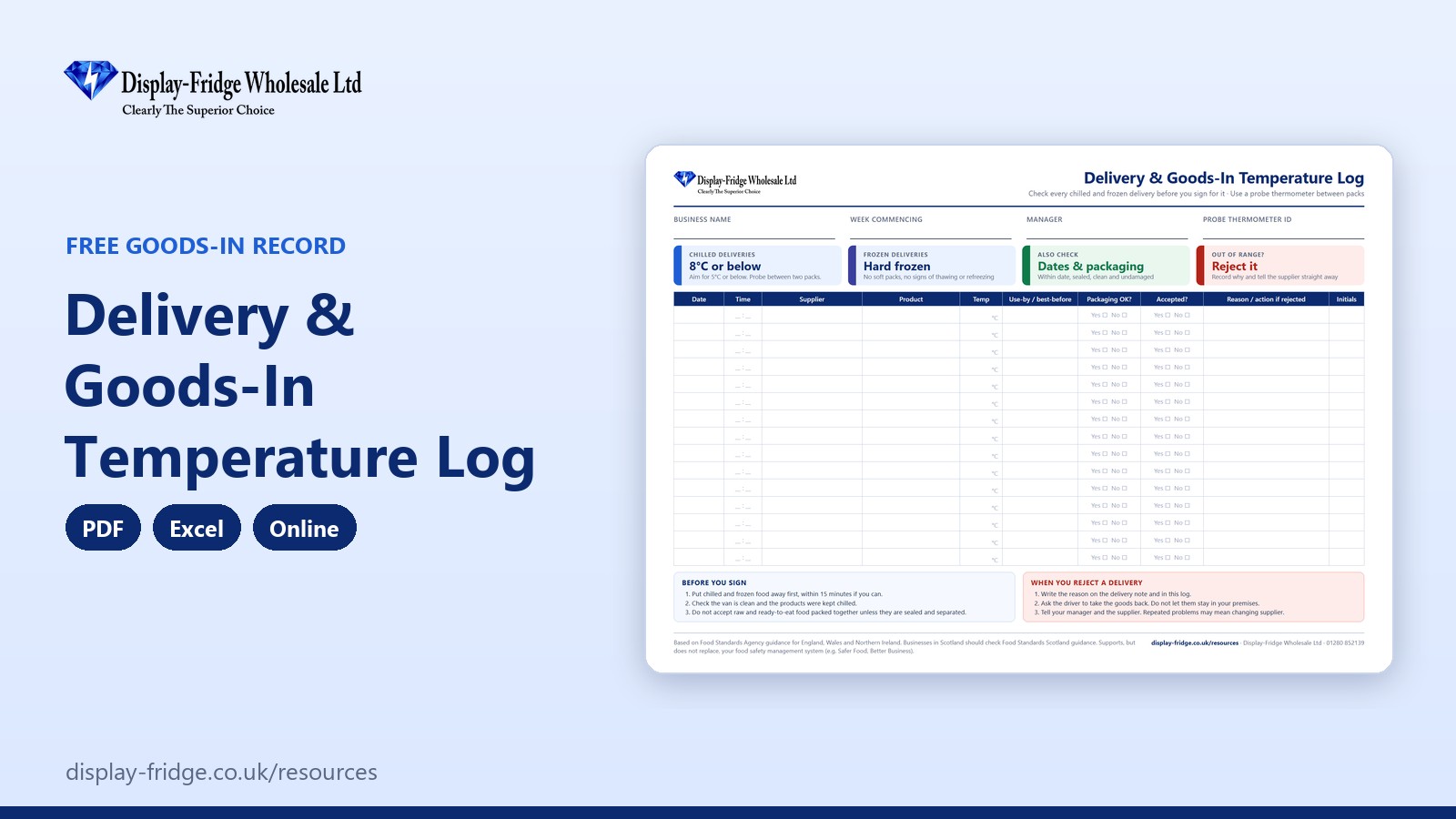
How to use the delivery log, step by step
Set up the log
Enter your business name. The limits follow FSA guidance; change them only if your food safety procedure is stricter. The counters show deliveries, deliveries flagged to reject and deliveries rejected.

Business name, limits and the summary counters Add each delivery as it arrives
Tap ‘+ Add a delivery’: the date and time fill in automatically. Enter the supplier and product, choose Chilled, Frozen or Ambient, then the temperature or whether frozen food is hard frozen, the use-by date and the packaging check.
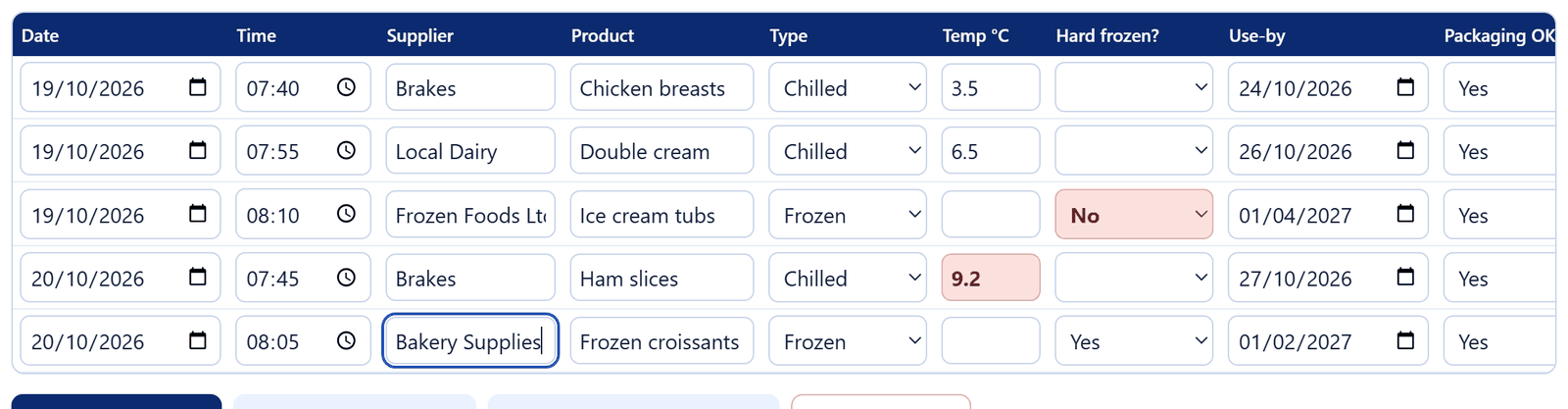
Five deliveries, with a warm chilled delivery and a thawed frozen one highlighted Act on the Check column
The Check column says ‘Reject’ when food is too warm, thawing, damaged or out of date. Choose ‘No’ under Accepted and write the reason and the action. Scroll the table sideways on a phone to see every column.
Keep your records
Print the log or save it as a PDF at the end of the week, or download a CSV file for Excel. Prefer paper? Print the PDF log and keep it by the back door.

Add, print, download and clear buttons
Good goods-in practice
- Keep a clean probe thermometer and probe wipes at the delivery point.
- Agree delivery times so someone trained is always there to check.
- Put chilled and frozen goods away first, within 15 minutes if you can.
- Keep raw and ready-to-eat deliveries apart, from the van to the fridge.
- Review the log monthly: a supplier with repeated problems needs a conversation, or replacing.
Related free resources
- Commercial Fridge Storage Guide: put deliveries away in the right place.
- Probe Thermometer Calibration Record: make sure the probe you use for deliveries is accurate.
- Fridge & Freezer Temperature Log: keep the food at the right temperature once it is in your fridge.
- All free resources.
These resources follow Food Standards Agency guidance for England, Wales and Northern Ireland. If your business is in Scotland, check the guidance from Food Standards Scotland. They support your food safety management system, such as Safer Food, Better Business, and do not replace it.