 0 items –
Ask ten café owners which food safety records they have to keep and you will get ten different answers. Some fill in a diary every day, some have a folder of sheets from the last owner, and some keep nothing in writing at all until an inspector asks. The truth is in the middle: the law does not hand you a fixed list of forms, but it does expect you to be able to show that your food safety procedures work, and records are how you show it.
This guide explains which food safety records a small food business is usually expected to keep, why each one matters and how to keep it without drowning in paperwork. It follows Food Standards Agency (FSA) guidance for England, Wales and Northern Ireland; if your business is in Scotland, check the guidance from Food Standards Scotland as well.
💡 Key takeaways
- Food businesses must have food safety procedures based on HACCP principles, with records that suit the size and type of the business.
- For refrigeration, the core records are fridge and freezer temperatures, deliveries, cooling, probe checks, cleaning and equipment servicing.
- Records only help if they show actions: what you did when a reading was out of range.
- Keep enough records to show an inspector a full history since their last visit.
- Free templates for every record below can be filled in online or printed.
What the law expects
Food businesses must put in place, and follow, food safety procedures based on the principles of HACCP (Hazard Analysis and Critical Control Points). In plain terms, that means working out where things could go wrong with your food, deciding how you control those points, checking that the controls work and keeping records that show it. The records should suit the nature and size of the business: a small café is not expected to keep the paperwork of a factory.
Many small businesses use the FSA’s Safer Food, Better Business (SFBB) pack, which combines the procedures with a daily diary. Others write their own HACCP plan. Either way, the day-to-day records described below sit underneath that system: they are the evidence that the procedures in your pack are followed.
Records also matter for your food hygiene rating. Inspectors look at how food is handled, the condition of the premises and how well food safety is managed. Clear, complete records are one of the easiest ways to show that last point. Our article on complying with food safety rules in a restaurant covers the wider picture.
The core refrigeration records
1. Fridge and freezer temperature log
This is the record inspectors ask for most often. Chilled food must be kept at 8°C or below in England, Wales and Northern Ireland, and most businesses aim to run their fridges between 0°C and 5°C. Freezers should be at −18°C or colder. Record every fridge, display cabinet and freezer at least twice a day, before you open and after you close, with the initials of the person who checked.
If you hot-hold food in a heated display cabinet, record that too: hot food on display must be at 63°C or above, checked at least every 2 hours by probing the centre of the food.

2. Delivery and goods-in log
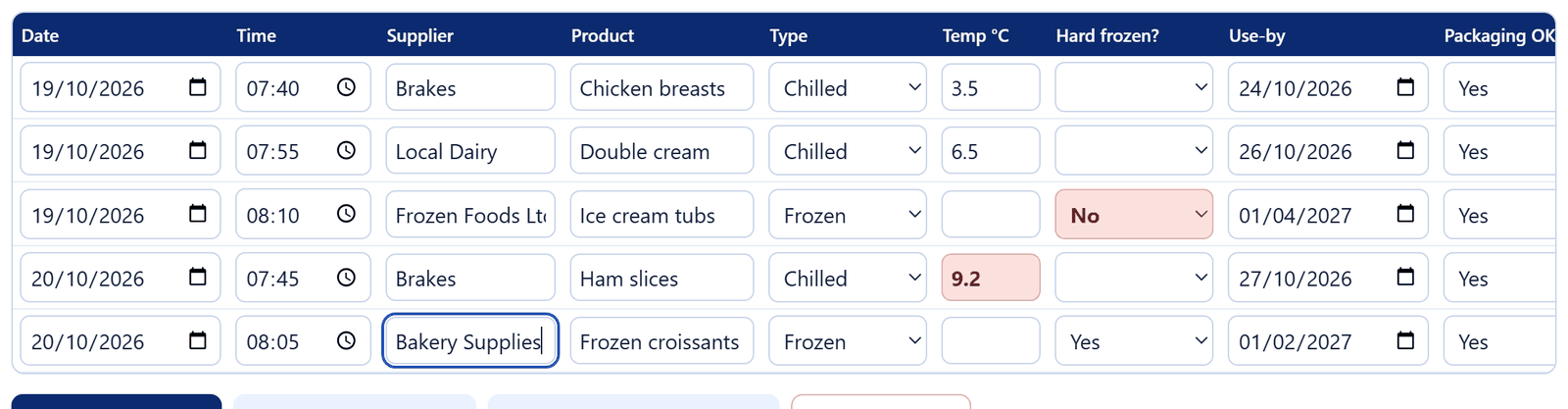
Your food safety starts before the food reaches your fridge. If chilled food arrives warm, or frozen food has started to thaw, putting it in a cold fridge will not undo the damage. Record every chilled and frozen delivery: the supplier, the product, the temperature or frozen state, the dates, the condition of the packaging and whether you accepted it.
Chilled food should arrive at 8°C or below, ideally 5°C or below. Reject it when it is too warm, when frozen food is not hard frozen, when packaging is damaged or dirty, or when food is out of date, and write down the reason. A supplier with repeated problems needs a conversation, or replacing.
3. Food cooling log
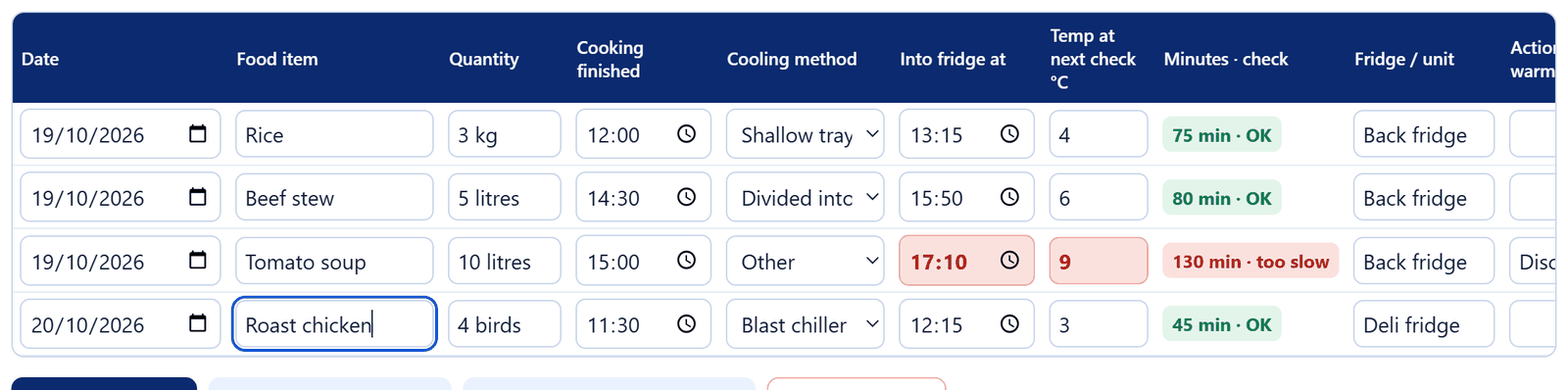
If you cook food and cool it for later, such as rice, stews, soups, gravies or joints of meat, you need to show that it cools quickly. Cooking kills most bacteria, but some produce spores that survive and grow again as food cools, fastest between 63°C and 8°C. The SFBB guidance is to cool food as quickly as possible, ideally within 90 minutes, and then put it in the fridge.
Record when cooking finished, how the food was cooled and when it went into the fridge. If cooling took too long, write what you did and what you will change, for example smaller containers or an ice bath.
4. Probe thermometer calibration record
Every other record on this list depends on your probe thermometer. If it reads 2°C low, a fridge at 9°C looks like 7°C and your temperature log is wrong without anyone knowing. Test each probe monthly in iced water (it should read −1°C to +1°C) and in boiling water (99°C to 101°C), and record the result.
5. Cleaning schedule
Inspectors look for a cleaning schedule as well as clean premises: a list of what is cleaned, how often and by whom, with a record that it was done. For refrigeration, that means wiping handles, glass and spills daily, cleaning shelves and door gaskets weekly, and a deep clean with the condenser brushed every month. Our guide to cleaning door gaskets shows the weekly job in detail.
6. Equipment register and service log
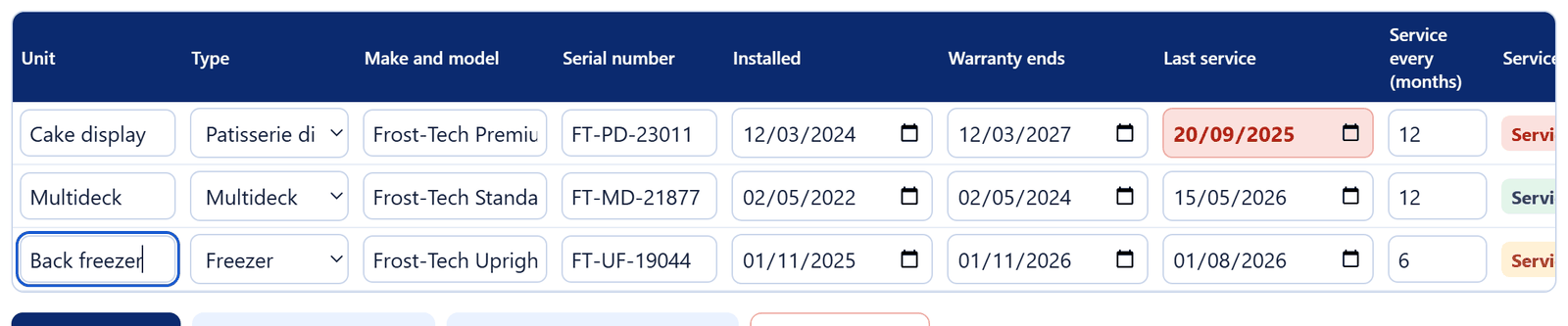
Keep one list of every fridge, display cabinet and freezer, with its model, serial number, location, installation date, warranty and service history. Update it after every service, repair or breakdown. A professional service at least once a year is a sensible minimum, every six months for units in hot or busy areas.
The register is not only for inspectors. It tells you which warranties are about to end, which units are overdue a service and which ones have cost the most in repairs.
Supporting records that make the core ones easier
Two more resources are not records in the strict sense, but they make the records above much easier to keep. The Daily Opening & Closing Checklist builds temperature, date and storage checks into a single routine for whoever is on shift. The Commercial Fridge Storage Guide is a poster for every fridge door that shows which shelf each food belongs on, so raw and ready-to-eat food are kept apart.
It is also worth writing a breakdown plan before you need one: who to call, where the back-up storage is and what to do with food in the first ten minutes. Our Fridge Breakdown Emergency Plan has the template.
How long should you keep food safety records?
For as long as your food safety management system says. As a rule, keep enough to show an inspector a full history since their last visit, and keep any records linked to a complaint or incident. Paper sheets can go in a ring binder by month; the online versions of our resources can be printed or downloaded at the end of each month and filed the same way.
Common mistakes with food safety records
- Readings with no actions. A temperature of 9°C written down with nothing next to it shows a problem was seen and ignored.
- Perfect numbers every day. Identical readings in the same pen for weeks suggest the log was filled in at the end of the month.
- No initials. Every check should show who did it.
- An untested probe. Without a calibration record, an inspector cannot trust any of your other temperatures.
- Old equipment nobody tracks. A fridge with no service history is the one most likely to fail on the hottest day of the year.
If your records keep showing the same unit struggling, the problem may be the equipment rather than the routine. A fridge that cannot hold 5°C on a warm afternoon is costing you stock and electricity. The running cost calculator shows what it costs to keep, and our commercial fridges and commercial freezers show what a replacement would cost.
Frequently asked questions
Do small food businesses have to keep food safety records?
Food businesses must have food safety procedures based on HACCP principles and keep records that suit the size and type of the business. The law does not prescribe particular forms, but written records such as temperature logs are the usual way to show inspectors that the procedures work.
Is a fridge temperature log a legal requirement in the UK?
The law requires chilled food to be kept at 8°C or below in England, Wales and Northern Ireland and requires procedures based on HACCP principles. It does not prescribe a temperature log as such, but written temperature records are the usual way to show compliance and inspectors expect to see them.
What food safety records do inspectors ask for?
Most often fridge and freezer temperature records, delivery checks, cooling and hot-holding records, cleaning schedules and evidence that probe thermometers are checked, together with your food safety management system such as Safer Food, Better Business.
How long should food safety records be kept?
For as long as your food safety management system says. Keep enough to show an inspector a full history since their last visit, and keep any records linked to a complaint or incident.
Do food safety records replace the Safer Food, Better Business diary?
No. Detailed logs and checklists work alongside SFBB or your own HACCP plan. Many businesses use them as the day-to-day record and note a summary in the SFBB diary.
About Display-Fridge Wholesale
Good records show that your fridges work. Good fridges make the records easy to keep: a cabinet that holds its temperature through a busy day gives you green readings and fewer actions to write down.
We are a UK supplier of commercial fridges and commercial freezers by Frost-Tech, based in Buckingham and supplying food businesses across the country. Our range covers multideck open fridges, glass door drinks fridges, cake and patisserie displays, deli and serve over counters, grab and go fridges, heated display cabinets, upright storage fridges, under counter fridges, glass door display freezers and chest freezers, most of them in a Standard and a Premium version so you can match the cabinet to your budget.
We also stock spare parts such as door gaskets, fan motors and controllers, deliver free to most of mainland England and Wales, and publish free food safety resources for UK food businesses. Not sure which cabinet you need? Read more about us, browse the frequently asked questions or call us on 01280 852139 and we will help you choose.




👉 SHOP OUR COMMERCIAL FREEZERS