
 0 items –
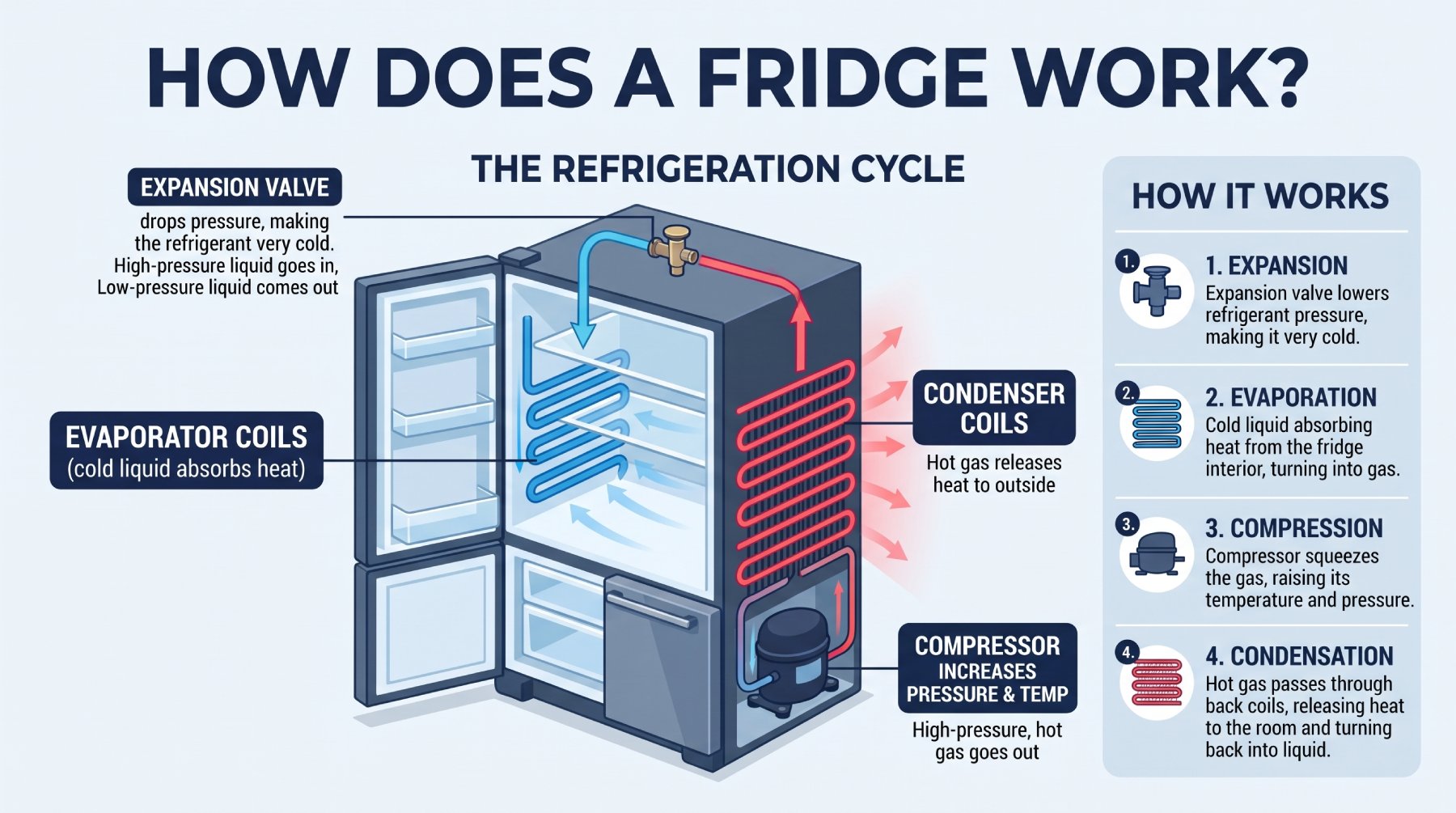
Refrigerators are an essential part of the modern world. They keep food fresh and safe for consumption.
A refrigerator is a cooling appliance that is used to store food and drinks. It works by using a refrigerant, which is a chemical that changes from liquid to gas when it is heated. The gas then cools the air in the fridge, which makes it colder.
What is a Refrigerator?
 A refrigerator is a device that keeps food and drinks cold.
Refrigerators are one of the most indispensable kitchen appliances. They can keep food and drinks cool by running on electric power. A refrigerator is a box that has a large compartment at the top, which is cooled to maintain a temperature that’s below room temperature.
It uses electricity to cool down the inside of the appliance, which then absorbs heat from its contents. This process of removing heat from inside the fridge creates an environment where it’s too cold for bacteria to grow.
Refrigerators also have a motorized compressor, which pumps refrigerant around the system to help maintain this temperature difference.
The temperature in a refrigerator will typically be between 33-40 degrees Fahrenheit (0-4 degrees Celsius).
What are the Types of Refrigerators?
Refrigerators are vital to the everyday life of many people. They store food and drinks, keep them fresh, and provide a place for people to keep their groceries.
Refrigerators come in three different types: domestic, commercial, and industrial. Domestic refrigerators are typically found in homes, apartments, or small office buildings. The commercial fridges are used in restaurants, grocery stores, and hospitals and they are essentially for food-related businesses. They help to keep food fresh for many days at a time by providing cool temperatures which inhibit bacteria growth. Industrial refrigerators are used to keep products cold during shipping. They can be used in factories or warehouses for food storage, medical supplies, vaccines, etc.
Read also about:
- Commercial Fridges vs Domestic Refrigerators
- How Does a Fridge Work?
- Guide to Selecting the Right Fridge for Your Shop
- How to Maintain your Commercial Fridge
What is the difference between a domestic and a commercial fridge?
A domestic refrigerator is smaller than a commercial fridge and it is used to store food at home.
A refrigerator is an appliance that maintains a temperature below the freezing point of water. This is accomplished by either blowing air over metal coils heated by electric current or by circulating a liquid such as freon through the coils. It provides cool air and prevents food from spoiling.
The domestic fridge is not a good fit even for small restaurants, motels, and other establishments. If you want to make the most of your storage space, you need a commercial refrigerator.
A commercial fridge is a larger version of a residential model and is used in restaurants, supermarkets, hospitals, schools etc. They come in a variety of sizes to suit different needs and have been designed to keep food cool for longer periods of time.
Domestic Refrigerator Definition

A domestic refrigerator is a cooling appliance that keeps food fresh and preserves its flavour. It is used to store various types of food for longer periods of time.
A domestic fridge is a chiller that is used at home, typically in the kitchen. It can be either an upright fridge or a chest freezer.
Commercial Fridge Definition
 The commercial fridge is a type of refrigeration appliance that is used in a commercial setting. It is designed to store and preserve perishable goods at a temperature below normal room temperature.
Commercial refrigerators are typically larger than residential models, and come in different styles, depending on the needs of the business. They may have more shelves or storage space or be designed for specific purposes such as storing food products or medicines. They can be upright drinks fridges, upright storage fridges, multideck open fridges, glass front fridges, or deli counters.
Industrial Fridge Definition
 An industrial fridge is a type of refrigerator that is typically used in large-scale food production.
Industrial fridges are usually larger than standard household refrigerators and are designed for the purpose of long-term storage.
Industrial refrigerators are a crucial component of the supply chain. They can be used to keep products cool during the shipping process. This helps maintain their quality and reduces the risk of spoilage or contamination from foreign bacteria. Using industrial refrigerators in this way can also reduce transportation costs because a large volume of liquid is not required for cold air transport.
Industrial fridges are used in warehouses, factories, hospitals, and other large-scale industries for storing goods. The difference between the standard refrigerator that is found in most homes and an industrial fridge lies in the temperature settings. Industrial fridges are generally set at a temperature of -25 degrees Fahrenheit or below to store items that should not be exposed to warmer temperatures.
How to Choose the Right Size of Refrigerator?
Refrigerators come in a variety of sizes, with different capacities and dimensions. The size of your refrigerator is important because it will determine what you can store in it.
A fridge is only as good as the space inside of it. With their large size, refrigerators are perfect for storing large quantities of food and drink items. A smaller refrigerator may be better for wine drinkers or those who consume little food or drink on a daily basis.
Domestic refrigerators are smaller than commercial ones, but they are perfect for use in homes or small businesses. Commercial refrigerators come in large sizes that can hold more food than domestic ones, but they’re too large for most households.
How to Choose the Right Type of fridge for your Business?
There is a wide variety of fridges that you can choose from. You need to take into account the size, the type and the running costs as well as how much storage space you need.
The first thing that you need to consider is whether or not your fridge will be an upright or a chest style. Upright fridges are more expensive but they also have more storage space and they are easier to clean. Chest style fridges are cheaper and easier to install but they don’t have as much storage space and they’re harder to clean.
You also need to consider what type of business you will be using your fridge for – whether it’s a patisserie, delicatessen or just a small shop. If it’s a patisserie then you will want a glass front fridge.

Refrigerators History
The basis for refrigerators was first introduced in 1755 when Prof. Cullen designed his small machine that used a pump and ether to cool things below the temperature of the water. Lowering the boiling point of the ether with a vacuum pump meant that boiling ether could absorb less heat to maintain its original state.
The next step was taken by American inventor Oliver Evans in 1805 who created a closed-cycle refrigeration machine based on the properties of ether. Its boiling point was lowered by the vacuum. This idea, and the prototypes that made it happen, weren’t practical until Jacob Perkins built the first vapour-compression refrigeration system in 1834. His system had a closed cycle and could operate without waste. Although practical, it did not succeed commercially due to it not being a financially viable solution.
American physician John Gorrie built a working prototype in 1842 and planned to use it for cooling the air in tropical homes, but this one was also a commercial failure. James Harrison was the first to patent an ice-making machine in 1856, following his move to Australia. The first models of the refrigerator’s electrolytic cooling system used either ether, alcohol or ammonia but later models used ammonia dissolved in water and sulfur dioxide methyl chloride.
The modern refrigerators history
Wolf invented the home refrigerator in Fort Wayne, Indiana, in 1913. However, he didn’t come up with the idea for refrigerators. That was first introduced by Nathaniel Wales in 1914. The first refrigerators were made in 1906 by Alfred Mellowes. This model used a compressor that was placed inside the cabinet. In 1918, Kelvinator Company bought his idea and soon after began mass production. Kelvinator Company was founded in 1918 after they copied the design of the original Kelvinator from Nathaniel B. Wales, which allowed for automatic temperature control. This year, black fridges accounted for 80% of the market share.
In 1922, Swedish inventors Baltzar von Platen and Carl Munters invented the “absorption refrigerator” which relies on a heat source to power its cooling system. Earlier fridges were often engineered with motors and compressors in the basement that sent cold air up to the main fridge. The fridge itself was often located in close proximity to where people were, particularly in the kitchen. The first self-contained unit that sat outside of this particular construction was introduced in 1923 by Frigidaire. It had all its parts in one enclosure.
The first widely available refrigerator was the GE “Monitor Top” refrigerator from 1927. They used sulfur dioxide or methyl formate as the refrigerating medium but these are dangerous if leaked so safer alternatives were sought. Back in the 1920s, there was a team of researchers to find a replacement for leaded gasoline because it pollutes too much. They found that Freon isn’t entirely safe either, but it’s better than what we had before.

Conclusion
Fridge use has increased over the past few decades. This is due to the increased quality of food, as well as the increase in popularity of fast-food restaurants. These two factors have contributed to a more sedentary lifestyle for many Brits.
Fridges are a great invention. They allow us to store and preserve food and drinks at low temperatures. These appliances can also be used to store medicines, lab samples, vaccines and other items that need to stay cold or frozen. However, it is important not to open the fridge too often as this wastes energy and creates unnecessary heat which could spoil the food inside.
More articles:
How to store fruits and vegetables in a grocery store
10 Ways to Improve Supermarket Food Sales
How to Maintain the Food Fresh in a Store
How to Organise your Commercial Fridge in the store